By James Islington
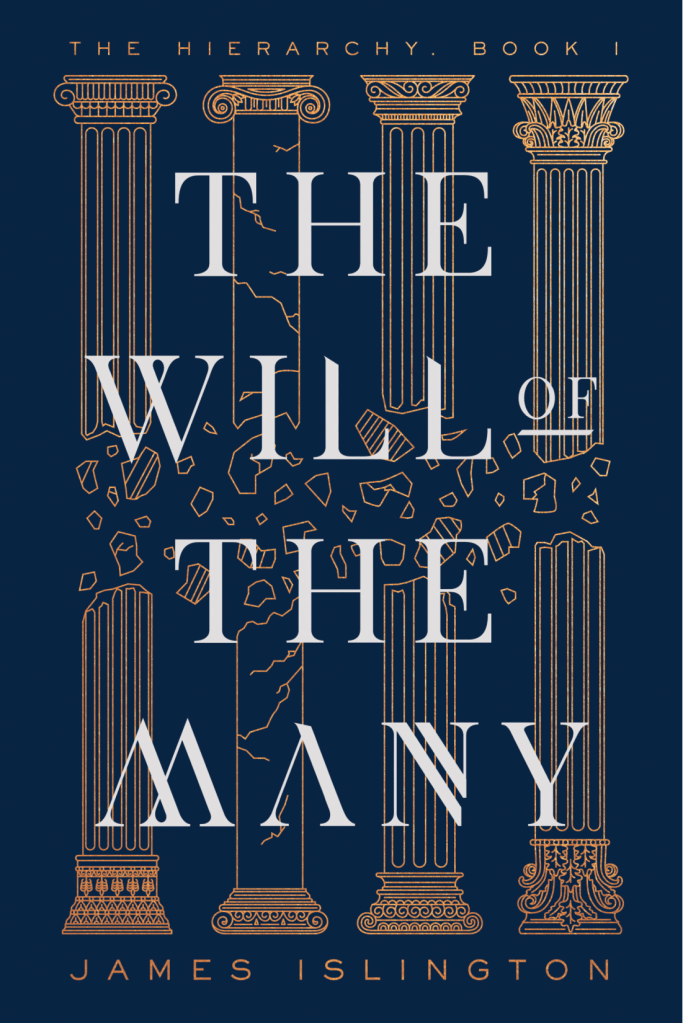
Summary:
Vis, a teenage fugitive orphaned when the Hierarchy invaded his homeland, finds himself navigating life within the society who took everything from him. While working in a prison, and entering fighting tournaments at night, Vis meets the charismatic Ulcisor, a relatively high-level senator within the Hierarchy’s government. Forming a relationship, Ulcisor sends Vis on a quest to infiltrate the Hierarchy’s elite Academy to uncover the mystery surrounding the death of Ulcisor’s brother, Caeror.
What follows is a face paced, relentless story about a young boy, with determination and sheer force of Will (pun intended), who fights to find a place in the society who would kill him if they found out his true identity, all the while seeking revenge on those who murdered his family.
Setting:
Set over a Roman-inspired backdrop complete with colosseums and togas, Islington’s world of the Hierarchy (the series namesake), is immersive and captivating. Using the “magic school” trope, Islington’s use of this genre is unique due to the magic system.
The overall world of the Hierarchy takes a dystopian society and dresses it up to be a functioning and efficient civilization.
Magic System:
Will, the form of currency that drives the use of magic, is literally the will given from one person to another. Every person belongs within a pyramid, where the lowest on the pyramid give up their Will to those above them. The higher in the pyramid a person is, the stronger their application of Will. Unlike other magic systems, Islington’s “Will” magic system is categorically scientific and academic. Subjects such as weight, mass, and even philosophy play a role in the use and application of Will. Students within the academy study rigorously to maximize their potential use of Will to achieve higher rankings within the Hierarchy upon graduation. The higher academic class a student achieves, the higher their chance of placement within the Hierarchy.
The magic system within the world of the Hierarchy just has a different feel to it compared to other contemporary fantasy novels, where the magic has a foundation in theoretical and practical applications. Islington’s application of this system throughout various conflicts in the novel prove that magic in this universe operates on a different playing field.
Writing:
Islington’s writing is at the same time complex yet forgiving. One of the most difficult challenges to reading The Will of the Many, in my opinion, is the use of Roman inspired vocabulary. To assist readers with this, Islington’s gives us a glossary to help with pronunciation.
Otherwise, Islington’s writing is straight and to the point. I was never left having to reread a paragraph to understand what was happening, yet Islington’s use of prose never left me wanting more.
Take away:
This was my first Islington novel and I loved every second of it. Islington’s writing keeps the pages turning, and his use of the magic school trope, modified to fit within the world of the Hierarchy, was a unique and refreshing spin on the sub-genre.
What I loved most about The Will of the Many was how unique the magic system is. As I previously mentioned, magic within this story is grounded in practical applications. Other fantasy novels use magic as just a thing that can happen, and only some people can use it. In The Will of the Many, magic is a system that everyone contributes to, from the base of a pyramid to the top, and a person can only master it through rigorous study and practice.
The Roman inspired setting is a breath of fresh air as well. Not many fantasy novels use inspiration from Roman society, and while the names may be a challenge for readers no familiar with Roman civilization (such as myself), architecture such as a colosseum gives the setting a unique perspective while also contributing the progression of plot.
If you’re a lover of fantasy, this book is for you!
 Novel Nook
Leave a comment